Is GHK-Cu the Same as the Copper Peptide in a Serum?
GHK-Cu is glycyl-L-histidyl-L-lysine complexed 1:1 with copper(II), and Canada's Cosmetic Regulations require it to appear on a cosmetic label under its INCI name, Copper Tripeptide-1, while a research vial specifies the same complex by mass and HPLC purity instead.
GHK-Cu is glycyl-L-histidyl-L-lysine complexed 1:1 with copper(II), and on a cosmetic ingredient list in Canada it must appear under its INCI name, Copper Tripeptide-1, because the Cosmetic Regulations require INCI nomenclature. The same complex in a research vial is specified by mass and HPLC purity instead. It is one molecule under two labelling systems, and neither label states what the other does.
What is GHK-Cu chemically, and what does the "Cu" add?
GHK is glycyl-L-histidyl-L-lysine: three amino acids joined by peptide bonds, molecular formula C14H24N6O4, molecular weight 340.38 g/mol (PubChem CID 73587). On its own the sequence carries no metal. GHK-Cu is that same three-residue chain with a copper(II) ion coordinated inside it, bound by the terminal amine, the deprotonated amide nitrogen between the glycine and histidine residues, and the imidazole nitrogen of the histidine side chain, arranged in a near square-planar geometry (Freedman et al., 1982). Coordinating that ion raises the mass: PubChem lists the neutral 1:1 complex at approximately 401.9 g/mol, an increase of roughly 61.5 g/mol over the free tripeptide, accounting for the copper atom and the loss of two hydrogens on binding. The copper is not an additive mixed into a formulation afterward; it occupies a specific site inside the tripeptide's own structure. That same coordination environment also governs the complex's colour, examined in the note on the d–d transition that makes the complex blue elsewhere in this journal.
Why does a Canadian cosmetic label say "Copper Tripeptide-1" rather than GHK-Cu?
The Cosmetic Regulations, C.R.C., c. 869, state at section 21.2(1) that "a list of ingredients must appear on the outer label of a cosmetic, with each ingredient listed only by its INCI name." INCI name is defined in the same regulations as the name assigned to an ingredient in the International Cosmetic Ingredient Dictionary and Handbook, published by the Personal Care Products Council. The name assigned there to GHK-Cu is Copper Tripeptide-1. The chemistry name and the regulatory name are not two casual ways of writing the same thing for a reader's convenience. Under section 21.2(1), an ingredient that has an INCI name and is not among the scheduled exceptions must appear under that INCI name. For Copper Tripeptide-1, that is the only lawful ingredient-list entry in Canada. "GHK-Cu" is a chemistry designation; "Copper Tripeptide-1" is the label.
Does "copper peptides" (plural) always mean GHK-Cu?
No. "Copper peptides" is a category term, not a single molecule's name. AHK-Cu, alanyl-L-histidyl-L-lysine complexed with copper(II), is a different tripeptide sequence and a different complex from GHK-Cu, and would carry its own INCI entry on a cosmetic label; this article has not verified that entry and does not state it. Other copper-tripeptide complexes exist under their own INCI names besides Copper Tripeptide-1. A product description that says "copper peptides" without naming an INCI entry does not identify which complex, or how many complexes, are present. The INCI name specifies the molecule; the category phrase does not.
What does a cosmetic ingredient list tell about quantity, and what does a research label tell?
Section 21.4(1) of the Cosmetic Regulations states that, subject to listed exceptions, "ingredients must be listed in descending order of predominance, in their concentration by weight." Section 21.4(2) then carves out an exception: "ingredients that are present at a concentration of 1% or less and all colouring agents, regardless of their concentration, may be listed in random order after the ingredients that are present at a concentration of more than 1%." So a Canadian cosmetic ingredient list conveys rank above the 1% line and no reliable rank below it. Ingredients at 1% or less may be listed in any order, so an ingredient near the end of the list could sit anywhere from just under 1% down to a trace, and no provision requires the exact percentage to appear on the label. A research vial's label works on a different basis entirely: it states a fill mass directly, typically a milligram quantity of lyophilized powder, alongside a separate HPLC purity figure. The two are different measurements: the mass is a fill quantity, the purity is a chromatographic ratio, and neither is a net-peptide-content assay. It also carries the research-use notice on the vial and no cosmetic labelling status at all. The failure mode this invites runs the other way: reading "copper peptides" on a cosmetic label as though it stated a quantity of GHK-Cu, when a Canadian ingredient list gives position rather than percentage below the 1% threshold, and the phrase itself may denote a different copper complex altogether.
Why do both forms carry a protect-from-light instruction?
Copper(II) complexes of this kind are photosensitive: the coordination environment responsible for the visible absorbance is also a site where photochemical reactions can proceed under sustained light exposure, independent of storage temperature. That is the chemical reason behind the instruction, stated on Aurum's own handling notes for GHK-Cu, to keep the material protected from light. The instruction follows from the copper coordination chemistry itself, so it applies to the complex under either labelling system, because the chemistry does not change with the label. What temperature range keeps a lyophilized peptide stable is a separate question, addressed elsewhere in this journal, and light exposure is not interchangeable with it.
What this does not establish
None of the above establishes what concentration of GHK-Cu sits in any specific cosmetic product: position on an ingredient list is not a percentage, and nothing here converts one into the other. It does not establish that a cosmetic label naming Copper Tripeptide-1 and a research vial naming GHK-Cu describe material of comparable purity, coordination state or formulation; the two labels answer different questions under different rules and were never built to be read against each other. It does not establish the INCI status of any copper-tripeptide complex other than Copper Tripeptide-1, which is the only INCI name this article has verified. And it does not establish anything about a finished cosmetic product's composition from a research vial's specification, or the reverse; the two labelling systems describe two different materials that happen to contain one molecule, a formulated cosmetic and a lyophilized research chemical, not one material seen from two angles.
What Aurum specifies for GHK-Cu, and what it does not
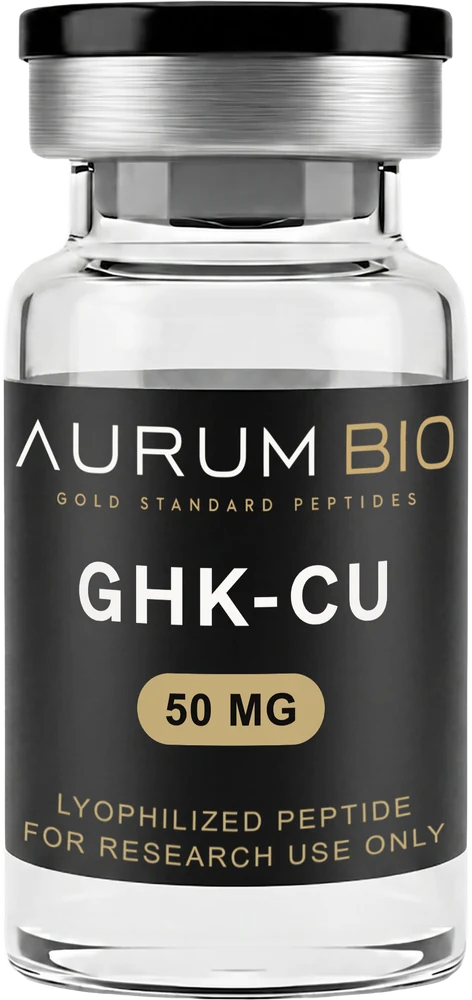
Aurum's GHK-Cu is specified as a lyophilized fill mass, a reverse-phase HPLC purity figure and an intact-mass identity check by mass spectrometry. It is a research-use chemical, not a cosmetic ingredient, and nothing on this page compares two sources of one ingredient; it compares two labelling systems. Aurum publishes no copper-content assay, no coordination-state data and no formulation, and states nothing about any finished cosmetic product. The catalogue entry carries that HPLC purity and fill mass under the research-use classification described elsewhere in this journal: not a net-peptide-content figure, not a shade, not a percentage on an ingredient list, and not a claim about what a differently labelled product on a different shelf contains.
| Attribute | Cosmetic ingredient list (Canada) | Research vial |
|---|---|---|
| Name on label | Copper Tripeptide-1 (INCI name) | GHK-Cu |
| Governing rule | Cosmetic Regulations, C.R.C., c. 869, s. 21.2(1): each ingredient listed only by its INCI name | No cosmetic ingredient-labelling rule applies; the vial carries a research-use notice |
| Quantity stated | Position in the list only, per s. 21.4(1)–(2); no percentage is required, and order below 1% may be random | Mass stated directly, typically in milligrams |
| Form | Aqueous formulation (typical for a serum) | Lyophilized powder |
| Identity information given | INCI name only | HPLC purity figure plus intact-mass identity by mass spectrometry |
References
- 01Freedman JH, Pickart L, Weinstein B, Mims WB, Peisach J Structure of the Glycyl-L-histidyl-L-lysine–copper(II) complex in solution. Biochemistry, 1982.
- 02Health Canada Industry Guide for the Labelling of Cosmetics. Consumer Product Safety, Government of Canada. https://www.canada.ca/en/health-canada/services/consumer-product-safety/reports-publications/industry-professionals/labelling-cosmetics.html.
- 03Government of Canada Cosmetic Regulations, C.R.C., c. 869. Justice Laws Website, ss. 21.2, 21.4. https://laws-lois.justice.gc.ca/eng/regulations/c.r.c.,_c._869/fulltext.html.
Every citation links out to the paper on PubMed. Identifiers are omitted deliberately rather than reproduced from memory, so where we do not hold a verified PMID or DOI the link is a PubMed search for that exact title — it resolves to the paper without anything being invented.
FOR RESEARCH USE ONLY · NOT INTENDED FOR HUMAN CONSUMPTION. This article describes compounds and the research literature in which they appear. Nothing here is a recommendation, protocol, or statement of effect.