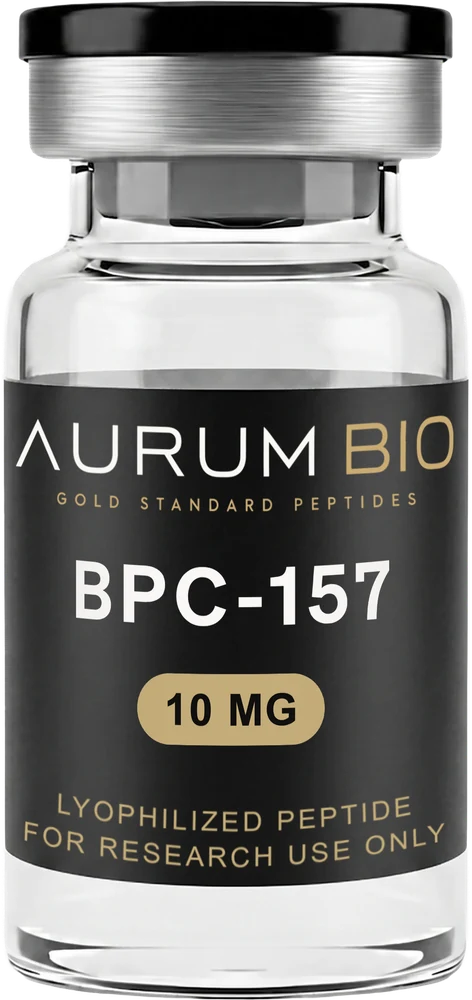

What Is the Amino Acid Sequence of BPC-157?
The sequence, formula and molecular weight of BPC-157 are theoretical reference values computed once from the residue order; an intact-mass identity match confirms composition against them, not the order itself.
BPC-157 is a synthetic pentadecapeptide, fifteen amino acids in the sequence Gly-Glu-Pro-Pro-Pro-Gly-Lys-Pro-Ala-Asp-Asp-Ala-Gly-Leu-Val, with the molecular formula C62H98N16O22 and an average molecular weight of 1419.55 g/mol. The sequence is the N-terminal fragment of a protein identified in gastric juice, carries no disulfide bridge and no side-chain modification, and is the reference against which a mass-spectrometric identity check is read.
What does the sequence Gly-Glu-Pro-Pro-Pro-Gly-Lys-Pro-Ala-Asp-Asp-Ala-Gly-Leu-Val specify?
The sequence specifies an order, read from the free amine at position 1 to the free carboxyl at position 15: a glycine, a glutamic acid, three consecutive prolines, a second glycine, a lysine, a fourth proline, an alanine, two consecutive aspartic acids, a second alanine, a third glycine, a leucine and a valine. Each residue links to its neighbours by an ordinary peptide bond; nothing in the chain is branched, cyclized or cross-linked. The one-letter shorthand for the same order is GEPPPGKPADDAGLV, fifteen characters for fifteen residues.
| Position | Three-letter | One-letter | Residue mass (Da, avg.) | Running total (Da) |
|---|---|---|---|---|
| 1 | Gly | G | 57.05 | 57.05 |
| 2 | Glu | E | 129.12 | 186.17 |
| 3 | Pro | P | 97.12 | 283.29 |
| 4 | Pro | P | 97.12 | 380.41 |
| 5 | Pro | P | 97.12 | 477.53 |
| 6 | Gly | G | 57.05 | 534.58 |
| 7 | Lys | K | 128.17 | 662.75 |
| 8 | Pro | P | 97.12 | 759.87 |
| 9 | Ala | A | 71.08 | 830.95 |
| 10 | Asp | D | 115.09 | 946.04 |
| 11 | Asp | D | 115.09 | 1061.13 |
| 12 | Ala | A | 71.08 | 1132.21 |
| 13 | Gly | G | 57.05 | 1189.26 |
| 14 | Leu | L | 113.16 | 1302.42 |
| 15 | Val | V | 99.13 | 1401.55 |
Summing the fifteen residue masses gives 1401.55 Da. Residue mass already accounts for the water lost when each peptide bond forms, but the finished chain still carries a free amine at one end and a free acid at the other, so one water's worth of mass, 18.02 Da, is added back once to close the calculation. 1401.55 Da plus 18.02 Da is 1419.57 Da. The 0.02 Da difference from the 1419.55 g/mol reported for the compound is rounding accumulated across fifteen residue masses carried to two decimals, not a discrepancy in the formula: computed directly from C62H98N16O22, the average mass falls between 1419.54 and 1419.56 depending on which table of standard atomic weights is used.
Why is it called a pentadecapeptide, and what does the "157" refer to?
"Pentadecapeptide" is a count, not a description: penta- and deca- together give fifteen, and the sequence above has fifteen amino acid residues. The term states a fact about the specification rather than a property discovered after the fact. A chain of ten residues would not earn the word, and neither would one of twenty.
The compound is frequently introduced in the pharmacology literature by the name assigned to it there: "stable gastric pentadecapeptide BPC 157," a name that records the residue count, a stability property reported for the compound in that literature, and the tissue source of the parent protein, without this article characterizing what that reported stability consists of. The BPC prefix is an acronym from the originating literature; its expansion describes a proposed property rather than anything the specification fixes, and is not reproduced here.
The "157" has no derivation documented in the primary pharmacology literature reviewed for this article. Where a numbering scheme is not sourced in the publications themselves, the accurate description is that it is the developers' own designation, assigned when the sequence entered their programme, and nothing more specific is asserted here. Provenance and proposed mechanism sit outside the specification and are addressed separately in this journal; this article stays with sequence, formula, mass, and what a matched mass can and cannot show.
What do the formula and molecular weight let an analyst check?
A molecular formula and a molecular weight are theoretical values, computed once from the sequence and independent of any single batch. C62H98N16O22 and an average molecular weight of 1419.55 g/mol are the figures a measured value is compared against, not a description of anything intrinsic to one vial. The same formula and weight are reported consistently for this sequence under CAS 137525-51-0 across independent chemical databases, which is what makes the registry number usable across suppliers rather than specific to one.
Mass spectrometry weighs, chromatography counts: the instrument reports a mass, and identity confirmation asks whether that measured mass falls within the instrument's stated tolerance of the theoretical 1419.55 Da. A matched mass says the analyzed material has the right atomic inventory summed to the right total, not that every atom sits in the position the reference sequence puts it in.
Which residues set the peptide's charge, and why does that matter for the salt form?
Of the fifteen residues, one side chain is basic: the lysine at position 7, whose amine carries a proton under typical aqueous conditions. The free amine at the N-terminus, on the glycine at position 1, is a second basic site on the chain. Three side chains are acidic (the glutamic acid at position 2 and the two aspartic acids at positions 10 and 11), and the free carboxyl at the C-terminus, on the valine at position 15, is acidic as well. The chain carries more acidic than basic sites, so the unpaired peptide is net negatively charged in solution near neutral pH.
That charge is why a peptide of this kind is not typically isolated or supplied as a bare, unpaired chain: a basic or acidic site needs a counterion, and which counterion is chosen is a formulation decision separate from the sequence itself. US Patent 9,850,282 (inventor R. Rucman; assignee Diagen d.o.o.) discloses salt forms of this pentadecapeptide in which a basic amino acid, preferably L-arginine, serves as the counterion, at one to three counterion molecules per peptide molecule. This journal cites the document for the counterion chemistry only and does not reproduce the stability rationale the patent advances for it. Counterion choice is the same category of decision addressed, for a different molecule's acetate salt form, in a companion article in this journal: which counterion pairs with which ionisable site, a cationic counterion with an acidic side chain here, an anionic one with a basic side chain elsewhere, and what that pairing changes, is a question that generalizes across peptides even where the sequence and the counterion differ.
Why can an intact mass match and still not prove the sequence?
Leucine and isoleucine are constitutional isomers: identical molecular formula, an identical monoisotopic residue mass of 113.084 Da, and a different arrangement of the same atoms within the side chain. A mass spectrometer measuring intact mass cannot tell which one occupies position 14 from the mass alone, because the peptide's total mass is the same either way. Telling the two apart requires tandem mass spectrometry with fragmentation designed for that specific purpose, and it is not the default output of a routine intact-mass run.
The same limit extends to order. A chain built from the same fifteen residues arranged in a different sequence carries an identical total mass, because mass spectrometry sums atoms and is indifferent to how they are arranged along the chain. A clean peak at 1419.5 Da is a statement about composition, not about the order in which residues are joined. Reading it as proof of sequence is the specific failure this invites, and it is a routine one, because the peak looks identical either way. Composition and sequence are different measurements, in the same way that identity and quantity are different measurements, a distinction this journal covers separately in its account of how peptide testing is actually run.
What this does not establish
None of the figures above establish that a given vial's contents have been sequenced end to end. An intact-mass match is a composition check; a formula and a molecular weight are theoretical reference values computed once from the sequence; a residue table is a specification, not a measurement performed on a particular batch. None of it establishes anything about an effect in a living system. The specification is silent on that question by design, and nothing in a sequence, a formula or a mass answers it.
What Aurum confirms, and what it does not
Aurum's specification for BPC-157 is a fill mass, a reverse-phase HPLC purity figure and an intact-mass identity check by mass spectrometry. The identity check is the one this article bears on: an intact-mass match is consistent with this composition, but it does not by itself confirm residue order, and sequence-level confirmation by fragmentation is not claimed. None of the three is a net-peptide-content assay; the fill mass is a weighed quantity, not a measured mass of peptide. The sequence, the formula, the average molecular weight and the CAS number on this page are the reference values that measurement is checked against, not a record of what has been separately confirmed for a given lot.
References
- 01Sikiric P, Seiwerth S, Rucman R, Turkovic B, Rokotov DS, Brcic L, Sever M, Klicek R, Radic B, Drmic D, Ilic S, Kolenc D, Vrcic H, Sebecic B Stable gastric pentadecapeptide BPC 157: novel therapy in gastrointestinal tract. Current Pharmaceutical Design, 17(16):1612-32, 2011.
- 02Rucman R (inventor); Diagen d.o.o. (assignee) Stable pentadecapeptide salts, a process for preparation thereof, a use thereof in the manufacture of pharmaceutical preparations and a use thereof in therapy. US Patent 9,850,282 B2, issued December 26, 2017. Google Patents: https://patents.google.com/patent/US9850282B2/en.
- 03Xiao Y, Vecchi MM, Wen D Distinguishing between Leucine and Isoleucine by Integrated LC-MS Analysis Using an Orbitrap Fusion Mass Spectrometer. Analytical Chemistry, 88(21):10757-10766, 2016.
- 04He F, Emmett MR, Håkansson K, Hendrickson CL, Marshall AG Theoretical and experimental prospects for protein identification based solely on accurate mass measurement. Journal of Proteome Research, 3(1):61-7, 2004.
Every citation links out to the paper on PubMed. Identifiers are omitted deliberately rather than reproduced from memory, so where we do not hold a verified PMID or DOI the link is a PubMed search for that exact title — it resolves to the paper without anything being invented.
FOR RESEARCH USE ONLY · NOT INTENDED FOR HUMAN CONSUMPTION. This article describes compounds and the research literature in which they appear. Nothing here is a recommendation, protocol, or statement of effect.