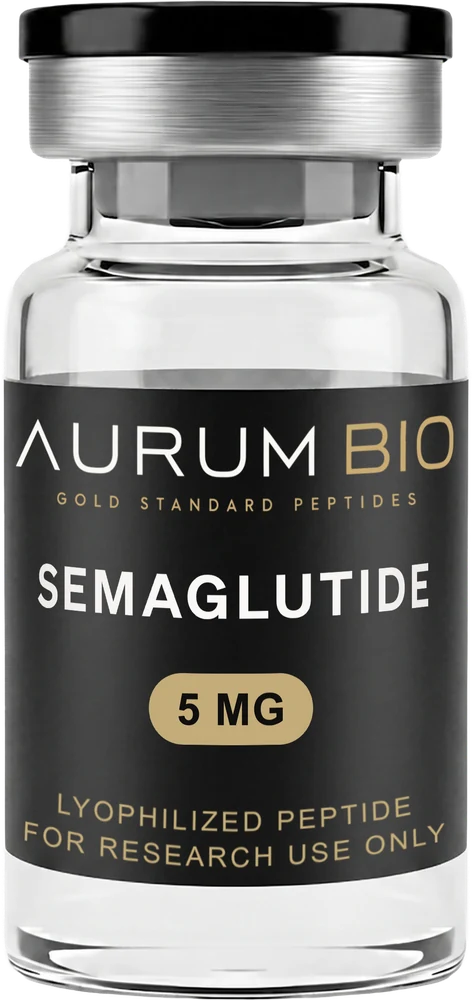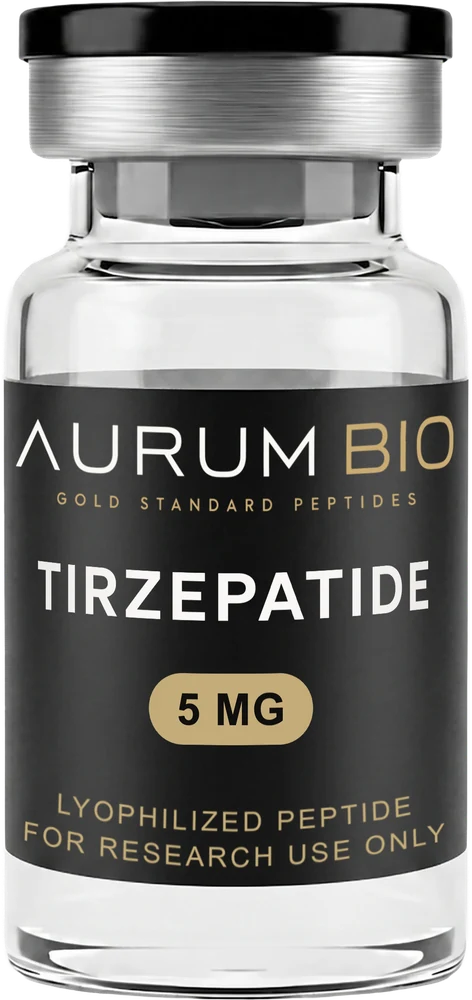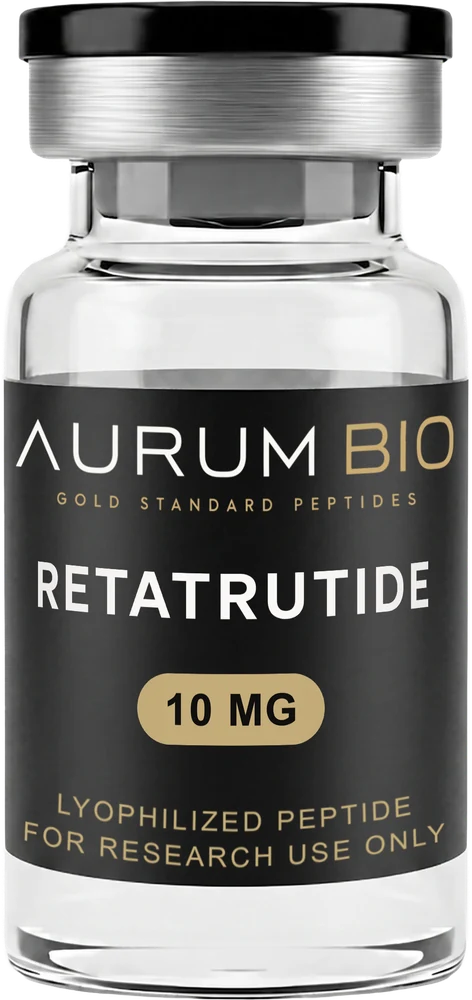

What Does 'Acetate' Mean on a Semaglutide Vial?
"Semaglutide acetate" names a salt, not a different compound: the peptide's free base carries a fixed sequence and mass, and the acetate counterions attached to its basic sites add mass that a chromatogram never registers.
"Semaglutide acetate" names a salt: the peptide, whose free base has the formula C187H291N45O59 and a molecular weight of 4113.58 g/mol, is paired with acetate counterions that balance its protonated basic sites. The salt form is a specification item, not a different compound, and it is the reason two listings can show two different molecular weights for the same 31-residue sequence. Reverse-phase HPLC purity at 214–220 nm does not register the counterion at all.
The same chemistry applies to any synthetic peptide with basic side chains, including the wider incretin-analogue class carried on this catalogue. What follows is the arithmetic behind the salt name itself, not a description of what any of these molecules does.
What is a peptide salt, and why does a synthetic peptide arrive as one?
A peptide's free base is the electrically neutral form of the molecule, the version drawn on paper with no ions attached. In practice, a peptide carrying basic residues (lysine, arginine, histidine) or a free N-terminal amine holds a positive charge at the pH where it is purified and isolated, because those groups are protonated under ordinary aqueous conditions. A positive charge needs a negative ion nearby to keep an isolated solid electrically neutral, and that negative ion is the counterion.
A synthetic peptide with basic sites essentially never exists as an isolated solid in pure free-base form. It exists as a salt, and the only open question is which counterion is attached, not whether one is present.
This holds independent of synthesis route or supplier. Solution-phase and solid-phase synthesis both finish with the same electrostatics: a molecule with a net positive charge in isolation, and a negative ion supplying the balance. The salt name on a specification is a record of that partner ion, appended after the peptide itself is already fully assembled.
Acetate or trifluoroacetate: why is the counterion set after synthesis, not by it?
Solid-phase peptide synthesis builds the chain on a resin and cleaves it free with a cocktail built around trifluoroacetic acid (TFA). TFA also dominates the mobile phase used in the reverse-phase HPLC step that purifies the crude peptide afterward. Both exposures leave trifluoroacetate sitting on the peptide's basic sites by default once purification is complete. It was not selected; it was present throughout the process.
Exchanging that default trifluoroacetate for acetate is a separate, deliberate step performed after purification, commonly a pass through an ion-exchange resin or repeated lyophilization from dilute acetic acid, either of which displaces trifluoroacetate from the same basic sites. Andrushchenko and colleagues, working on TFA removal by lyophilization from dilute hydrochloric acid, found that the acid concentration had to be kept low to remove trifluoroacetate without altering the peptide's secondary structure, and Roux and colleagues, comparing three exchange approaches on a model cationic peptide, found that reverse-phase HPLC and ion-exchange resin gave partial to near-complete exchange, and that only a deprotonation-reprotonation cycle removed trifluoroacetate entirely. Which counterion ends up on a finished vial reflects which of these post-synthesis steps the material went through, if any. It says nothing about the sequence that was built on the resin.
Neither counterion changes a single peptide bond, and the counterion is invisible to a 214–220 nm chromatogram either way: it is not retained on a reverse-phase column, so it travels with the mobile phase as baseline rather than eluting as a peak that purity integration would count.
Why do two listings for semaglutide show different molecular weights?
| Semaglutide | Tirzepatide | Retatrutide | |
|---|---|---|---|
| Residues | 31 | 39 | 39 |
| Free-base formula | C187H291N45O59 | C225H348N48O68 | C221H342N46O68 |
| Free-base molecular weight | 4113.58 g/mol | 4813.45 g/mol | 4731.35 g/mol |
| CAS number | 910463-68-2 | 2023788-19-2 | 2381089-83-2 |
On the same free-base basis, semaglutide is registered under CAS 910463-68-2 with the formula C187H291N45O59 and a molecular weight of 4113.58 g/mol; tirzepatide, 39 residues, is C225H348N48O68 at 4813.45 g/mol; and retatrutide, also 39 residues, is C221H342N46O68 at 4731.35 g/mol. A registry entry or a primary synthesis paper typically reports the free-base molecular weight above: the mass of the peptide alone, with no counterion attached. Lau and colleagues, describing the discovery of semaglutide, characterize the molecule by its sequence and its free-base identity, the convention used across the medicinal chemistry literature. A vial labelled as an acetate or TFA salt, by contrast, may be listed at a nominal salt weight that adds the counterion's mass on top of the free base.
Both figures can be correct at once, because they answer different questions: one is the mass of the peptide alone, the other is the mass of the peptide plus whatever ions are attached to it. Reading two such figures as competing values for the same quantity is the error, not either number by itself.
How much of the vial's mass can the counterion be?
The scale of the effect is worth working through, with the assumption stated plainly. A peptide with n basic sites, each carrying a counterion, gains n times that counterion's molar mass on top of its free-base weight. The table below applies that arithmetic to semaglutide's free-base mass of 4113.58 g/mol, using acetic acid's molar mass of 60.05 g/mol and trifluoroacetic acid's molar mass of 114.02 g/mol as the reference masses conventionally used for each counterion. n = 1, 2 and 3 are illustrative values only, chosen to show how the arithmetic scales. They are not a measured or claimed count of basic sites on semaglutide or on any specific lot. At n = 1, acetate adds 60.05 g/mol, about 1.4% of the resulting salt mass, and trifluoroacetate adds 114.02 g/mol, about 2.7%.
| Counterion | Reference molar mass | Added mass, n = 1 | Added mass, n = 2 | Added mass, n = 3 |
|---|---|---|---|---|
| Acetate (as acetic acid) | 60.05 g/mol | 60.05 g/mol (1.4% of salt mass) | 120.10 g/mol (2.8%) | 180.15 g/mol (4.2%) |
| Trifluoroacetate (as TFA) | 114.02 g/mol | 114.02 g/mol (2.7% of salt mass) | 228.04 g/mol (5.3%) | 342.06 g/mol (7.7%) |
Does the salt form affect how the lyophilized powder should be stored?
Lyophilized peptide salts are hygroscopic solids whichever counterion is present, and how readily a given powder takes up atmospheric moisture depends on the sequence and the salt together, not on the salt name alone. That is a reason to control residual moisture carefully regardless of counterion, but it does not change the general storage physics that applies to lyophilized peptide powder as a class, which is covered separately and not restated here.
What this does not establish
This arithmetic does not establish how many counterions are actually present on any specific Aurum lot, for semaglutide or any other compound; n above is an assumption chosen to illustrate scale, not a measurement. Nor does a molecular weight difference between two listings, on its own, indicate a different sequence or a different molecule. The most common failure mode in reading these listings is comparing two vendors' molecular weights for the same compound and concluding one is a different or wrong molecule, when one figure is the free base and the other is the salt.
None of this establishes net peptide content from a salt-form label alone, either. Net content is a separate measurement, and it cannot be derived from knowing which counterion is present any more than it can be derived from an HPLC purity figure by itself.
It also does not establish that a higher-molecular-weight listing represents more counterion mass by design rather than by rounding or reporting convention. Registries, synthesis papers and vendor listings do not follow one shared rule for which mass to publish, and the gap between two numbers can reflect that inconsistency as easily as it reflects the salt itself.
What Aurum states, and what it does not
Aurum's specification for each of the three is a fill mass, a reverse-phase HPLC purity figure and an intact-mass identity check by mass spectrometry; none of the three is a net-peptide-content assay, neither the counterion form nor net peptide content is stated, and the purity figure would read the same for an acetate salt and a TFA salt. Semaglutide, tirzepatide and retatrutide are the three incretin-class research peptides carried on this catalogue, and the same specification gap holds across all three: a listed mass and a listed purity percentage, with the salt form left unstated on the page itself.
References
- 01Lau J, Bloch P, Schäffer L, Pettersson I, Spetzler J, Kofoed J, Madsen K, Knudsen LB, McGuire J, Steensgaard DB, Strauss HM, Gram DX, Knudsen SM, Nielsen FS, Thygesen P, Reedtz-Runge S, Kruse T Discovery of the Once-Weekly Glucagon-Like Peptide-1 (GLP-1) Analogue Semaglutide. Journal of Medicinal Chemistry, 2015.
- 02Roux S, Zékri E, Rousseau B, Paternostre M, Cintrat JC, Fay N Elimination and exchange of trifluoroacetate counter-ion from cationic peptides: a critical evaluation of different approaches. Journal of Peptide Science, 2008.
- 03Andrushchenko VV, Vogel HJ, Prenner EJ Optimization of the hydrochloric acid concentration used for trifluoroacetate removal from synthetic peptides. Journal of Peptide Science, 2007.
Every citation links out to the paper on PubMed. Identifiers are omitted deliberately rather than reproduced from memory, so where we do not hold a verified PMID or DOI the link is a PubMed search for that exact title — it resolves to the paper without anything being invented.
FOR RESEARCH USE ONLY · NOT INTENDED FOR HUMAN CONSUMPTION. This article describes compounds and the research literature in which they appear. Nothing here is a recommendation, protocol, or statement of effect.