Why Is MK-677 Not a Peptide?
MK-677, or ibutamoren, is a small molecule that carries two amino-acid-derived residues on a spiro-indoline-piperidine scaffold, not a peptide built from a chain of amino acids, and the difference changes how identity and purity are actually measured.
MK-677, or ibutamoren, is not a peptide: it is a small molecule built on a spiro-indoline-piperidine core with the formula C27H36N4O5S and a free-base molecular weight of 528.7 g/mol, usually supplied as the mesylate salt at 624.8 g/mol. A peptide is a chain of amino acids joined by amide bonds; MK-677 contains two amide bonds and a two-residue amino-acid-derived fragment whose chain ends in a non-amino-acid scaffold, which is why the literature calls it a peptidomimetic rather than a peptide. It appears beside peptides on vendor lists because it was designed for the same receptor that ipamorelin was later built for, not because it shares their chemistry.
That distinction is not cosmetic. It determines which measurement answers the question of whether a sample is the intended material, at what wavelength a purity figure is read, and where MK-677 sits, or does not sit, inside a peptide catalogue.
What makes a molecule a peptide, and where does MK-677 fall outside that definition?
A peptide's backbone is built from repeated amide bonds, the carboxylic acid of one amino acid joined to the amine of the next, producing a chain of amino-acid residues that runs from two residues to several dozen before the term protein takes over, with an amino-acid residue at each end of it. The word classifies a whole molecule, not a substructure: a dipeptide is a peptide because the chain is the molecule. Ipamorelin is the working example inside this catalogue: molecular formula C38H49N9O5, molecular weight 711.9 g/mol, five residues, four amide bonds along the backbone carrying the chain in sequence, and a C-terminal amide rather than a free carboxylic acid. MK-677 has no such backbone. It carries two amide bonds and two amino-acid-derived residues: a 2-amino-2-methylpropanoyl unit, the building block chemists call Aib when it sits inside a peptide chain, joined to an O-benzyl-D-serine. The chain stops there. The serine carbonyl is bonded to the nitrogen of a spiro-indoline-piperidine that is not an amino acid, and that scaffold accounts for roughly half the molecule's mass. A two-residue fragment whose chain ends in a non-amino-acid scaffold that makes up roughly half the molecule is a peptide-derived unit built into a small molecule, not a peptide, and that is the distinction the word peptidomimetic exists to make.
| Ipamorelin | MK-677 (ibutamoren) | |
|---|---|---|
| Class | Pentapeptide, GHS-R1a agonist | Small molecule (peptidomimetic), spiro-indoline-piperidine core |
| Amide bonds | 4 amide bonds along the backbone, C-terminal amide | 2 (Aib–Ser; Ser–piperidine N), no repeating backbone |
| Residues | 5 (Aib-His-D-2-Nal-D-Phe-Lys) | 2 amino-acid-derived (Aib, O-benzyl-D-Ser), C-terminus capped by a non-amino-acid scaffold |
| Molecular weight | 711.9 g/mol (C38H49N9O5) | 528.7 g/mol free base (C27H36N4O5S); 624.8 g/mol mesylate (C28H40N4O8S2) |
| HPLC detection convention | 214–220 nm, amide backbone chromophore | Compound-specific chromophore; not read at the peptide convention by default |
| Supplied form | Lyophilized powder | Typically a crystalline solid (mesylate salt) |
What is a peptidomimetic, and why was MK-677 designed as one?
MK-677 originated at Merck in the 1990s, inside a discovery program that took the peptide compounds of the 1980s built for the growth hormone secretagogue receptor, Bowers' GHRP-6 among them, as its reference point and had already produced a first non-peptide compound, the benzolactam L-692,429. Those peptide compounds were built as short chains acting at a receptor that was still an orphan; its natural ligand, ghrelin, was not identified until 1999. Patchett and colleagues placed the compound in what they called a recently synthesized structural class. The design logic, a short amino-acid-derived fragment carried on a non-peptide scaffold, is set out in Smith and colleagues' review two years later, which describes the resulting compounds as peptidomimetics: molecules designed around a peptide's binding footprint without carrying a peptide's backbone. That is a design description, not a claim about performance; it explains why the structure looks the way it does under HPLC and mass spectrometry, and nothing more.
What does the growth hormone secretagogue receptor have to do with the grouping?
The receptor is the reason MK-677 appears in the same conversation as ipamorelin at all. Both are described in the literature as engaging the growth hormone secretagogue receptor, cloned and characterized by Howard and colleagues in 1996 as a receptor expressed in pituitary and hypothalamic tissue. Ipamorelin, the peptide in Aurum's catalogue, was first described by Raun and colleagues in 1998 as acting at that receptor; the comparison between CJC-1295 and ipamorelin examines at length why two receptors, not two versions of one, is the organizing distinction for the whole class. MK-677 was built to engage the same receptor by a different chemical route, a small molecule rather than a peptide agonist. Sharing a receptor target is a classification fact about where two molecules sit in the pharmacology literature. It says nothing about their chemistry, and chemistry is what determines whether a compound is a peptide.
What changes in analysis when the compound is not a peptide?
Reverse-phase HPLC purity figures for peptides are conventionally read at 214–220 nm, the range where the repeating amide bond of the backbone absorbs; what the detector sees at 214–220 nm is dominated by the chain itself, with aromatic side chains adding to the signal rather than defining it. That convention holds because every peptide, whatever its sequence, presents the same chromophore in roughly the same place. MK-677 has two amide bonds rather than a repeating backbone, and its dominant UV-absorbing groups are the N-methanesulfonyl-substituted indoline ring system and the aromatic benzyl ether, chromophores with their own absorbance behavior. A small molecule is read at whatever wavelength its own structure absorbs strongest, which is a separate method decision from the peptide convention, not the same measurement performed on a different compound.
That is where a stated purity figure stops being comparable across a vendor list on sight. On a peptide, the number is peak area at 214–220 nm, where the amide backbone absorbs. On MK-677, a small molecule with different chromophores, the figure is quantified at a different wavelength, often by a different method entirely, and the resulting percentages are not the same measurement even when a listing sets them side by side as though they were.
Physical form differs for the same structural reason. Aurum's peptides ship as lyophilized powder; MK-677's mesylate salt is typically a crystalline solid, which is standard for a small-molecule salt rather than a formulation preference.
Does the mesylate salt change the numbers on a label?
MK-677 is most often supplied as the mesylate salt rather than the free base, and that choice changes the numbers a label should carry. The free base, C27H36N4O5S, has a molecular weight of 528.7 g/mol, registered under CAS 159634-47-6. Adding one molecule of methanesulfonic acid to form the mesylate salt gives C28H40N4O8S2, a molecular weight of 624.8 g/mol, and its own registry number, CAS 159752-10-0. The two figures describe the same core structure carrying a different counterion, and a specification should state which one a molecular weight refers to. A listing that quotes 528.7 g/mol for material sold as the mesylate is reporting the free base's weight on the salt's label.
What this does not establish
None of this ranks MK-677 against ipamorelin by evidence quality or by potency; that comparison is out of scope here, because the question this article answers is chemical classification, not comparative pharmacology. Sharing a receptor target does not make two molecules chemically interchangeable, and a molecular formula does not indicate which compound is better characterized in the literature; each sits in its own body of work, and reading the two side by side for classification is a different exercise from grading them against each other. A structural classification also does not establish activity. Confirming that a sample matches the calculated formula and mass for MK-677 or for ipamorelin says the molecule present is the intended one. It says nothing about what happens at the receptor in any system, a separate question answered by a separate kind of study, not by HPLC or mass spectrometry.
What Aurum tests, and what it does not
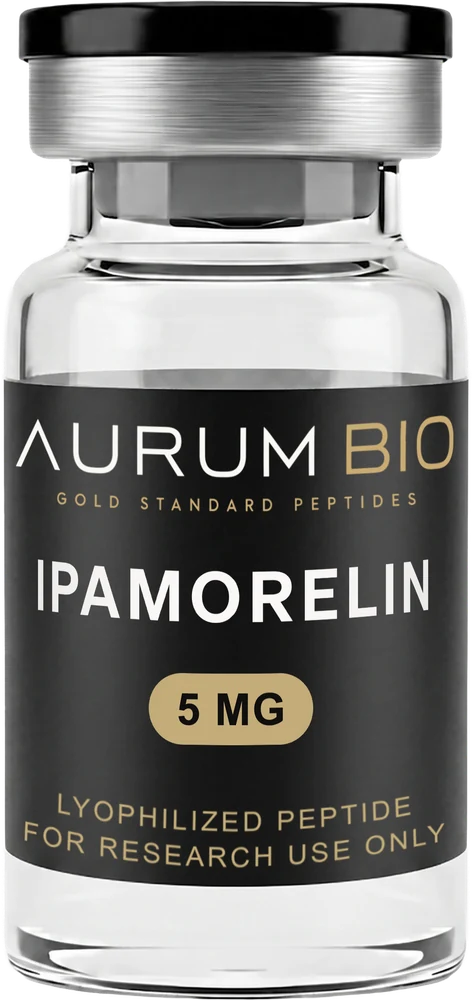
MK-677 is not in Aurum Bio's catalogue, and this page is not a listing for it. It exists to answer a classification question that comes up precisely because vendor pages routinely place MK-677 beside peptides such as ipamorelin without explaining why. Aurum's specification for ipamorelin, as for every catalogue peptide, is a fill mass, a reverse-phase HPLC purity figure and an intact-mass identity check by mass spectrometry; none of the three is a net-peptide-content assay and no bioassay is run, so nothing in Aurum's testing establishes receptor activity for ipamorelin or any catalogue compound, and the classification set out in this article is by structure, not by measured activity.
References
- 01Patchett AA, Nargund RP, Tata JR, et al. Design and biological activities of L-163,191 (MK-0677): a potent, orally active growth hormone secretagogue. Proceedings of the National Academy of Sciences of the United States of America, 1995.
- 02Smith RG, Van der Ploeg LH, Howard AD, et al. Peptidomimetic regulation of growth hormone secretion. Endocrine Reviews, 1997.
- 03Howard AD, Feighner SD, Cully DF, et al. A receptor in pituitary and hypothalamus that functions in growth hormone release. Science, 1996.
- 04Raun K, Hansen BS, Johansen NL, et al. Ipamorelin, the first selective growth hormone secretagogue. European Journal of Endocrinology, 1998.
Every citation links out to the paper on PubMed. Identifiers are omitted deliberately rather than reproduced from memory, so where we do not hold a verified PMID or DOI the link is a PubMed search for that exact title — it resolves to the paper without anything being invented.
FOR RESEARCH USE ONLY · NOT INTENDED FOR HUMAN CONSUMPTION. This article describes compounds and the research literature in which they appear. Nothing here is a recommendation, protocol, or statement of effect.