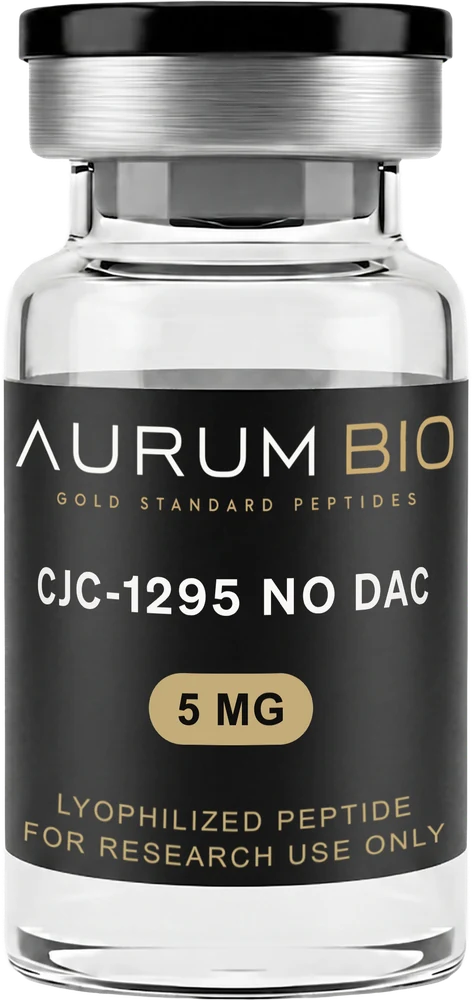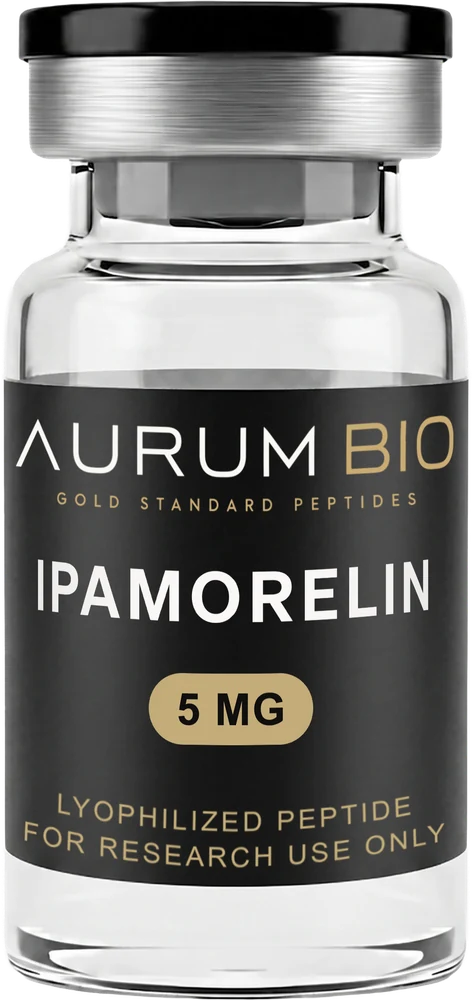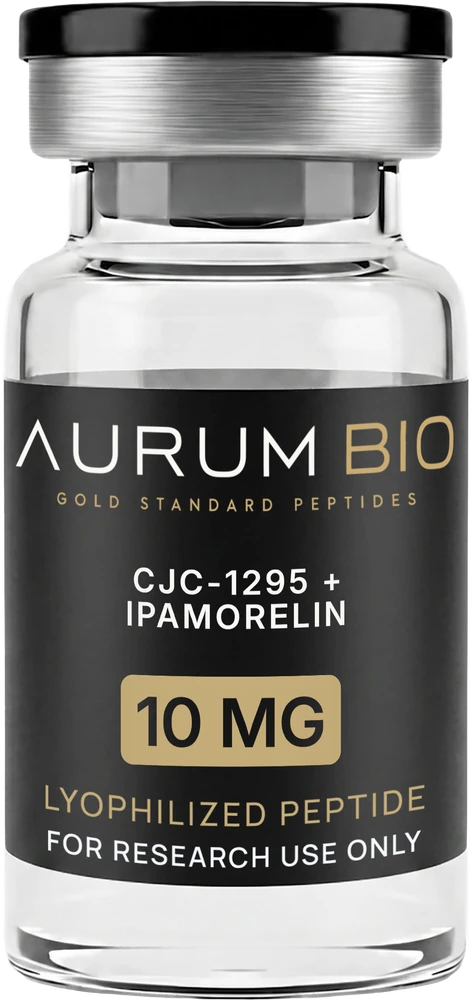

CJC-1295 vs. Ipamorelin
CJC-1295 and Ipamorelin appear side by side in almost every growth-hormone-axis discussion, which has quietly produced the impression that they do the same job. They do not. One is an analogue of the hypothalamic releasing hormone; the other is an agonist at the ghrelin receptor. The pairing is a mechanistic observation, not a synonym.
Somatotroph cells in the anterior pituitary sit under three separate inputs. Growth-hormone-releasing hormone (GHRH) stimulates them. Somatostatin inhibits them. Ghrelin, acting through the growth hormone secretagogue receptor, amplifies the response and appears to blunt the inhibitory arm. Any compound in this category acts on one of those three inputs, and knowing which one is the difference between understanding the literature and reciting it.
Two receptors, not two versions of one
| CJC-1295 (No DAC) | Ipamorelin | |
|---|---|---|
| Molecular class | GHRH analogue — modified GRF(1-29) | Synthetic pentapeptide secretagogue |
| Receptor | GHRH receptor (GHRH-R) | Ghrelin receptor (GHS-R1a) |
| Signalling pathway | Gs — adenylyl cyclase, cAMP, protein kinase A | Gq — phospholipase C, IP3, intracellular calcium |
| Size | 29 residues, four substitutions | 5 residues, C-terminal amide |
| Also known as | Mod GRF 1-29; CJC-1295 without DAC | NNC 26-0161 |
| Evidence tier | Preclinical + early human | Preclinical + early human |
Different receptor, different G-protein, different second messenger. That is about as far apart as two compounds acting on the same cell type can be.
CJC-1295 (No DAC): a stabilised fragment
Native GHRH is 44 amino acids long, but the first 29 residues carry the full biological activity — a finding that dates to the early characterisation of the hormone and underpins this entire compound family. GRF(1-29) is therefore the minimal working fragment, and it is also fragile: circulating half-life is measured in minutes, with DPP-4 cleavage at the N-terminus as the primary route of degradation.
The No-DAC form addresses that with four substitutions, each solving a distinct chemical liability:
- D-Ala at position 2 — blocks DPP-4 cleavage, the dominant degradation route.
- Gln at position 8 — removes an asparagine prone to deamidation.
- Ala at position 15 — associated with increased bioactivity in the analogue series.
- Leu at position 27 — removes a methionine prone to oxidation.
The result is a molecule considerably more stable than native GRF(1-29) while remaining short-acting relative to the DAC-conjugated version. Because it works through the GHRH receptor, its effect is constrained by the same feedback machinery that governs the native hormone — including somatostatin tone and negative feedback from IGF-1.
Ipamorelin: selectivity as the design goal
Ipamorelin is a pentapeptide agonist at GHS-R1a, the receptor for ghrelin. It was described by Raun and colleagues in 1998 as the first selective growth hormone secretagogue, and the word doing the work in that description is selective.
The secretagogues that preceded it — GHRP-6 and GHRP-2 among them — released growth hormone but also raised adrenocorticotropic hormone, cortisol and prolactin. Ipamorelin was characterised as releasing growth hormone without the corresponding rise in those hormones at comparable levels of activity. That specificity is the entire reason the molecule remained interesting after the earlier secretagogues had been described.
Two further features of GHS-R1a are worth knowing when reading this literature. It has unusually high constitutive activity — it signals to a measurable degree in the absence of any ligand — which complicates interpretation of agonist studies. And it is expressed outside the pituitary, including in the enteric nervous system, which is why ipamorelin also appears in gastrointestinal motility research and was investigated in early clinical work on postoperative ileus. It did not reach approval for that or any other indication.
Why they are discussed together
The rationale is mechanistic and it is reasonable on its face: the two arms of somatotroph regulation are separate, so engaging both is not the same as engaging one twice. Ghrelin receptor agonism has been reported to amplify GHRH-driven release and to act partly by opposing somatostatin, which is a different kind of contribution than simply adding more stimulus.
That is a hypothesis derived from receptor biology. It is not the same thing as a demonstrated result. No controlled study has been published comparing the two molecules directly, or characterising them in combination against either alone under conditions that would isolate the contribution of each. The commercially co-formulated blend reflects that hypothesis and market convention, not a finding.
Evidence, graded honestly
| Question | CJC-1295 (No DAC) | Ipamorelin |
|---|---|---|
| Receptor identified | Yes — GHRH-R | Yes — GHS-R1a |
| Human pharmacokinetic data | Published for the DAC form; thinner for No DAC | Early-phase human data exists |
| Completed phase 3 trials | None | None |
| Approved indication | None | None |
| Selectivity characterised | Inherent to GHRH-R binding | Explicitly, and it is the compound's defining property |
Handling and identity
Both are supplied as lyophilized powder, reconstituted with bacteriostatic water, with lyophilized material stored at −20 °C and reconstituted solution held at 2–8 °C and protected from light.
The identity check differs in difficulty. Ipamorelin is a five-residue peptide with unusual building blocks — an aminoisobutyric acid, a D-2-naphthylalanine and a D-phenylalanine — and those non-standard residues make its mass signature distinctive and hard to counterfeit convincingly. Modified GRF(1-29) is a 29-residue chain whose four substitutions are individually small; a certificate that reports only a molecular weight and a purity percentage does not confirm that all four substitutions are present. Sequence confirmation is the meaningful check here, and it is the one most often missing.
The short version
- Different receptors — GHRH-R versus GHS-R1a — and different second-messenger pathways.
- CJC-1295 (No DAC) is stabilised GRF(1-29); the four substitutions each fix a specific chemical weakness.
- Ipamorelin's defining published property is selectivity relative to earlier secretagogues, not potency.
- The pairing rests on receptor biology, not on any published head-to-head or combination study.
- For modified GRF(1-29), ask for sequence confirmation — molecular weight alone will not verify the substitutions.
References
- 01Raun K, et al. Ipamorelin, the first selective growth hormone secretagogue. European Journal of Endocrinology, 1998.
- 02Teichman SL, et al. Prolonged stimulation of growth hormone (GH) and insulin-like growth factor I secretion by CJC-1295, a long-acting analog of GH-releasing hormone, in healthy adults. Journal of Clinical Endocrinology & Metabolism, 2006.
- 03Jetté L, et al. hGRF1-29-albumin bioconjugates activate the GRF receptor on the anterior pituitary in rats: identification of CJC-1295 as a long-lasting GRF analog. Endocrinology, 2005.
- 04Howard AD, et al. A receptor in pituitary and hypothalamus that functions in growth hormone release. Science, 1996.
- 05Kojima M, et al. Ghrelin is a growth-hormone-releasing acylated peptide from stomach. Nature, 1999.
Every citation links out to the paper on PubMed. Identifiers are omitted deliberately rather than reproduced from memory, so where we do not hold a verified PMID or DOI the link is a PubMed search for that exact title — it resolves to the paper without anything being invented.
FOR RESEARCH USE ONLY · NOT INTENDED FOR HUMAN CONSUMPTION. This article describes compounds and the research literature in which they appear. Nothing here is a recommendation, protocol, or statement of effect.